Smart Parking Gate System
An Arduino-Based Parking Monitoring and Automated Gate Control Project
Parking management becomes inefficient when drivers cannot see whether spaces are available before entering. This often leads to unnecessary waiting, congestion, and repeated searching inside full parking areas.
To address this problem, my team and I developed a Smart Parking Gate System using Arduino, sensors, an LCD screen, a servo-controlled gate, LEDs, and a buzzer. The system monitors parking availability in real time and automatically controls vehicle access based on the number of available spaces.
Project Overview
The prototype was designed to simulate an automated parking facility. Sensors installed in the parking spaces detect whether each space is occupied, while an Arduino Uno processes the collected data.
The number of available spaces is displayed on an LCD screen at the entrance. When parking spaces are available, the gate opens automatically to allow the vehicle to enter. When the parking area reaches full capacity, the gate remains closed and the buzzer activates to alert the driver.

The complete Smart Parking Gate System prototype and project display, presented with the technical poster and physical parking model.
How the System Works
The system follows a simple automated process:
Sensors detect the presence of vehicles in each parking space.
The Arduino Uno receives and processes the sensor readings.
The available-space count is updated automatically.
The LCD screen displays the number of remaining spaces.
The servo motor opens the entrance gate when space is available.
If the parking area is full, the gate stays closed and the buzzer produces an alert.
This logic prevents additional vehicles from entering once all spaces are occupied.
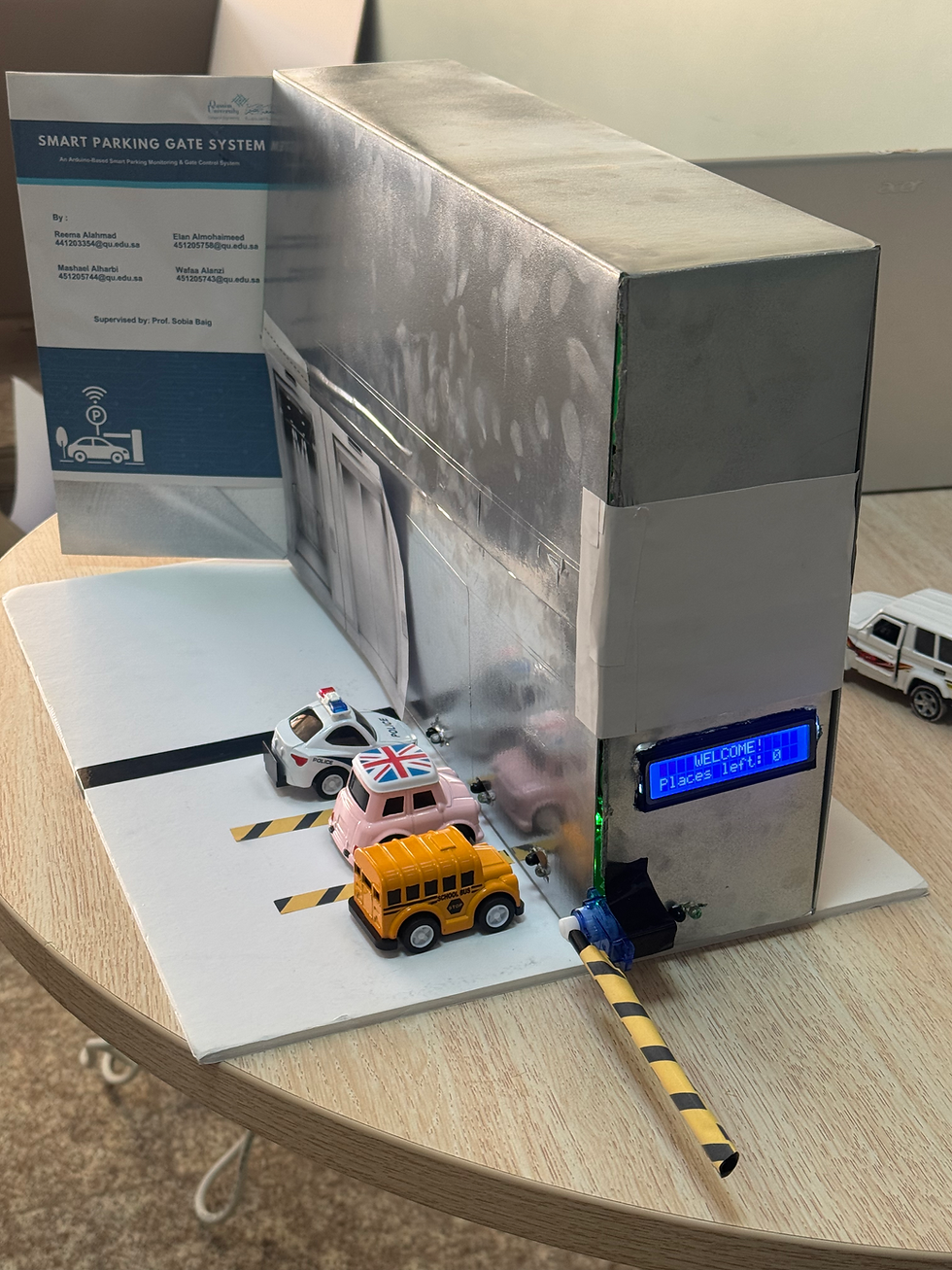
Front view of the prototype showing the LCD availability display, servo-controlled entrance gate, parking spaces, and vehicle models.
Main Components
The prototype included:
Arduino Uno
Vehicle-detection sensors
LCD display
Servo motor
Buzzer
LEDs
Breadboard and connecting wires
Physical parking model
Each component supported a specific function. The sensors monitored occupancy, the LCD communicated availability, the servo controlled entry, and the buzzer provided an audible warning when the parking area was full.

Close-up of the internal electronics, including the Arduino, breadboard connections, sensors, indicator lights, and buzzer.
System Integration
One of the most important parts of the project was integrating the sensing, display, warning, and gate-control functions into one system.
The Arduino continuously evaluates the sensor inputs and determines whether the parking area has available capacity. Based on this information, it updates the LCD and controls the servo motor and buzzer.
This integration transformed the project from a basic parking model into a functional automated control system.

Top view of the prototype’s internal wiring and control components connected to the parking sensors, LCD, buzzer, and automated gate.
Project Outcome
The final prototype successfully:
Detected occupied and available parking spaces.
Displayed real-time availability on the LCD screen.
Opened the gate when parking spaces were available.
Prevented entry when the parking area was full.
Activated the buzzer as a full-capacity warning.
Demonstrated how automation can improve parking access and reduce unnecessary congestion.
What I Learned
This project strengthened my understanding of:
Arduino programming
Sensor integration
Control logic
Circuit implementation
Servo motor control
Real-time data processing
Hardware troubleshooting
Technical documentation
Team collaboration
It also showed me how a relatively simple combination of sensors and control components can be used to solve a practical transportation and infrastructure problem.
Conclusion
The Smart Parking Gate System demonstrates how embedded systems and automation can improve everyday parking operations. By combining occupancy detection, real-time information, warning signals, and automatic gate control, the prototype provides a practical foundation for a larger smart parking solution.
Future improvements could include mobile application integration, cloud-based monitoring, license-plate recognition, online reservations, and a dashboard displaying parking activity and historical data.


Comments